
(19 March 2026) It is now 9 pm MST March 19, or, 4 AM GMT, March 20.
As of now, the Strait of Hormuz continues to be blocked. It has been blocked for 19 days. About 320 to 400 million barrels of oil have been removed from global oil supplies by Iran’s closing of the Strait of Hormuz.
The idea of the Second Signpost having started March 2 is still in play.
Whether the Strait of Hormuz is actually blocked or not may not matter for too much longer.
It is March 19, 2026, the middle of the current seven-year cycle. There was a possibility of something significant happening in this war, due to the midpoint of the Shemitah. Indeed, we saw an escalation. The IRGC threatened last night, and they did not wait long to carry out its threat.
Today, the IRGC attacked the Qatari natural gas field, two Kuwaiti refineries, a Saudi refinery on the shore of the Red Sea, and another tanker off the coast of the UAE.
Here are three news items here showing the worsening global conditions.
News Item 1: IRGC Shows it Can Stop Saudi’s Red Sea Oil
The SAMREF refinery in Saudi city of Yanbu was struck, though attack at minimal impact on operations.
The attack made the Saudis realize that the only route for oil could be in jeopardy.
News Item 2: Qatari Gas Field Hit Hard
A news report from oilprice says that between the IRGC attacks on the Qatari gas field, and the earlier Israeli attack on the South Pars field of Iran, one-fifth of all global liquid natural gas (LNG) has been shut off.
LNG is needed to make fertilizer. Fertilizer production is down 20 to 40 percent in some countries, which will have a direct effect on crop yields.
The third horseman cannot be too far away.
News Item 3: Damage to Oil/Gas Infrastructure
This Newsmax piece brings a few facts to light:
Iran’s LNG production is down. Iran depends on LNG for 80 percent of its electricity, and to cook its meals.
On the Qatari side of the largest gas field on earth, “The latest wave of missiles caused sizable fires and extensive further damage.”
Other reports suggest it will take years for Qatar to bring production back on line.
News Item 4: People Talking About $200 Per Barrel Oil
This news item from oilprice.com shows that $200 per barrel of oil is no longer crazy talk.
Quotes from the article are as follows:
“A month ago, any analyst suggesting international oil prices could soar all the way to $200 per barrel would have been laughed out of the studio. Now, some are beginning to acknowledge that this is a real possibility, and with good reason.”
“I wouldn’t be surprised if oil went to 200 bucks, or even 250, because commodity prices go parabolic when there’s a shortage of supply,” the chief market strategist of Longview Economics, Chris Watling, told the news outlet.”
Conclusion
With the IRGC’s attacks on Kuwaiti, Qatari, Saudi, and UAE oil infrastructure, following Israel’s attack on Iran’s South Pars gas field, the overall oil and gas available for export continues to shrink.
Some are entertaining the idea of $200 per barrel of oil and how that’s not crazy talk anymore.
My own estimates of the final oil price once the Middle East oil production is shut down completely is somewhere around $400 to $500 per barrel. The chart below shows how a price of $90 for WTI translates into $4 per gallon of gasoline. At $450 per barrel, that is $20 per gallon of gasoline.
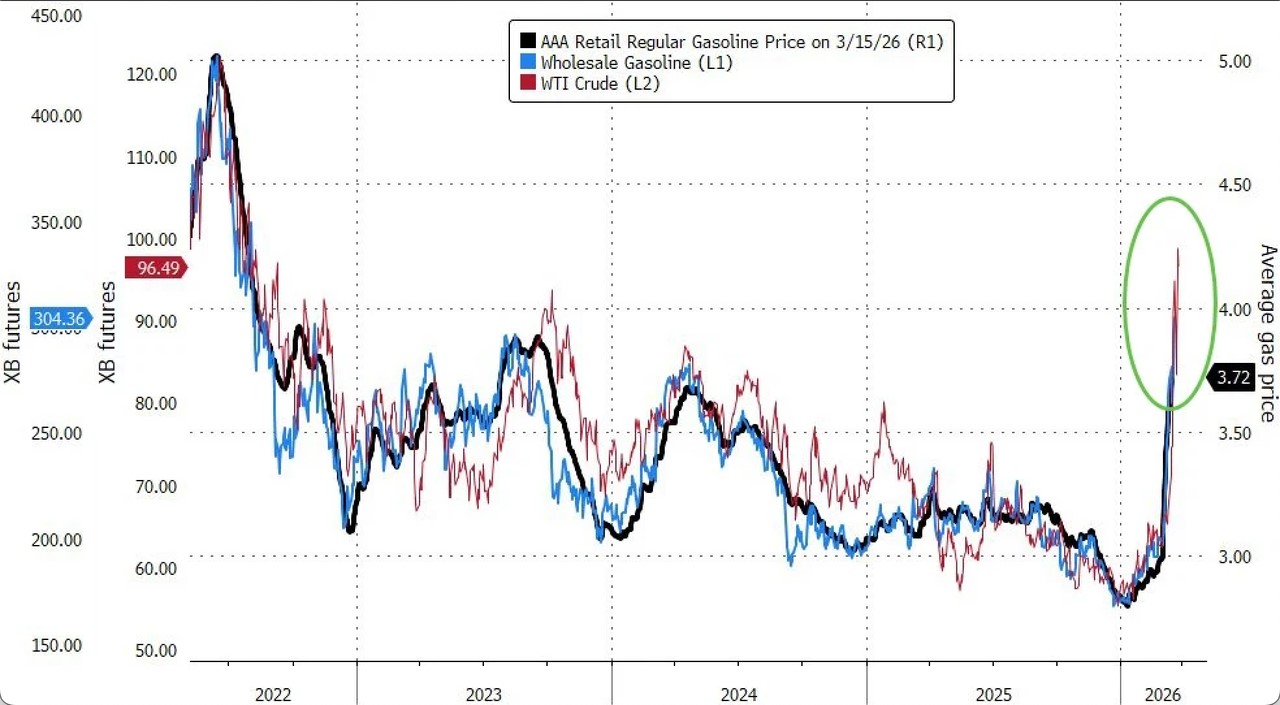
Just as WTI at $90 per barrel is $4 per gallon gas, both can be multiplied by a factor of 5.
At $20 per gallon for gas, that would unleash plenty of other economic problems. At that point we could say the second horseman would be in a full gallop at taking away the peace of mind of the earth.
Brace yourselves—as you know, the invasion by Iran and wholesale slaughter in Muslim countries in the Middle East would be next.
Keep watch.
Categories: ALERT, In The News, Signpost #2: Iran
 THE FOUR SIGNPOSTS
Leave a comment