
(17 April 2026) It is now 10 pm MST April 17, or, 5 AM GMT, April 18. As of now, the Strait of Hormuz has been blocked for 48 days.
The Second Signpost began March 2, unless the oil starts flowing again from the Middle East allowing the world to restore the oil and chemical business.
Will the Strait Re-Open and For How Long?
Iran agreed in a deal with the US to open the Strait to all traffic, but the US will continue to blockade any tankers associated with Iran.
So the Strait might open for a while.
However, Trump said the Strait will stay open only until Wednesday if no peace deal is reached.
So the Strait might close again in a few days.
With these few days of a supposedly open Strait, eight tankers are going to test going through with full cargoes to see if they can go through.
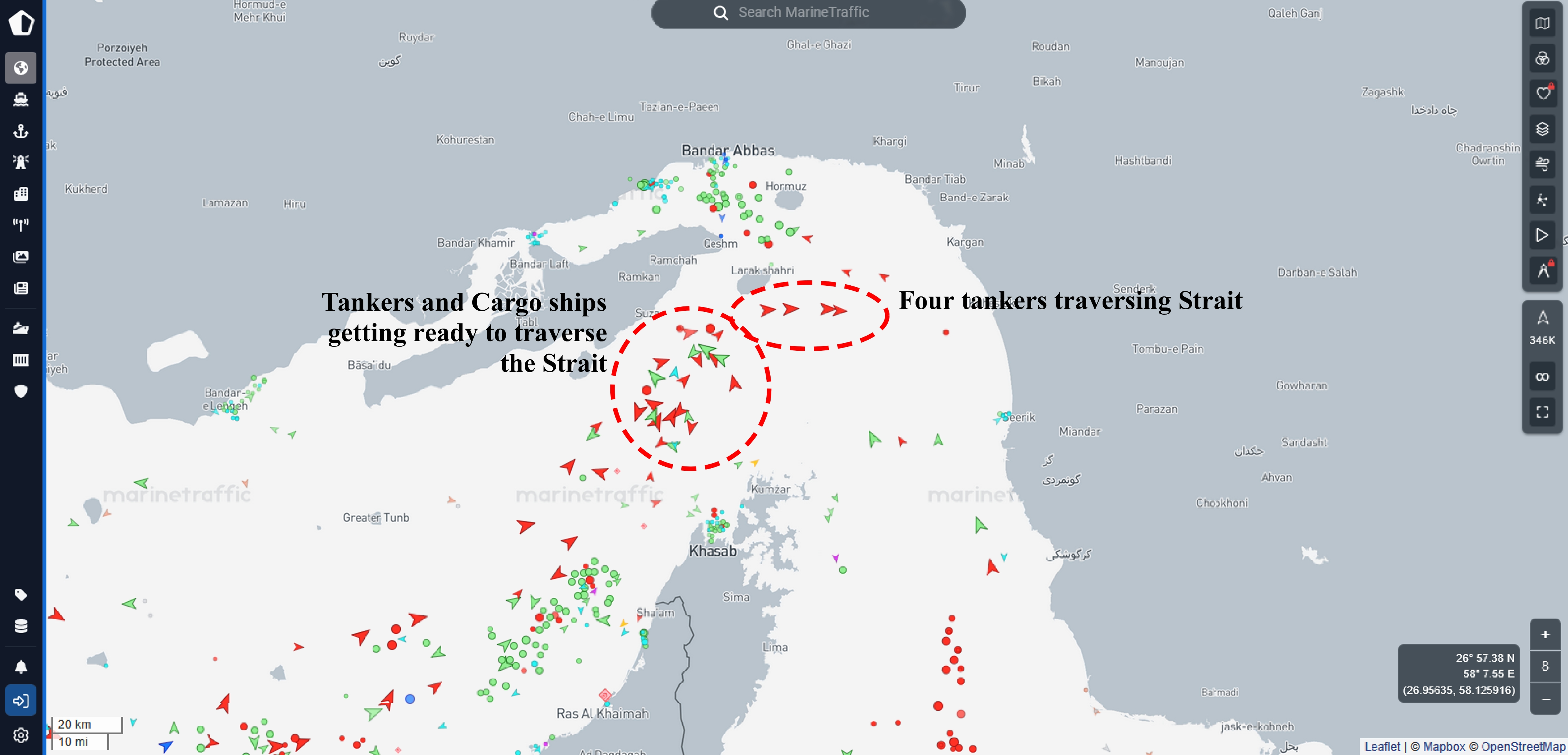
Snapshot of lack of crude oil tanker traffic through Strait of Hormuz on April 15, 5 am GMT, 2026. From marinetraffic.com. Note the tankers starting to test the Strait.
Conclusion
We will see. Even if the Strait fully reopens it will take many weeks to a few months to get production going again in the Gulf countries since most of it was shut down. On the other hand, Iran could still destroy one of the tankers to cause fear again among insurers, shutting down the Strait again.
Keep watch.
In the meantime get those gardens going because even if the Strait re-opens, the fertilizer shortage is now baked in to the growing season.
Categories: In The News, Signpost #2: Iran, USA in the End Times, World in the End Times


Seven hours ago, the IRGC by maritime radio declared the Strait closed again. They made sure the message was understood by immediately attacking with their speedboats. They damaged two container vessels from India that wanted to get through the Strait. The vessels turned around.
Immediately after this happened the government of The Netherlands (previously known as Holland) activated Phase One of the “National Crisisplan Oil”. This plan was made after the energy crisis in the first year of the Ukraine war. A part of this crisisplan is public. There are rules for when to declare a certain phase, depending on how much oil and oil products are still available. Phase Zero was already active, for how long is unknown.
Phase 0: Activate sleeping government structures for crisis management. Prepare emergency laws and measures. Increase communication with EU and IEA.
Phase 1: Closely monitor everything concerning oil, natural gas, oil products and energy. Communicate to the public what is going on.
Phase 2: Ask public and industries to save oil and energy. Give suggestions how. Ask industries, where possible, to increase production of those oil products which are most needed. All on a voluntary basis.
Phase 3: Force public and industries to save oil and energy. Force industries, where possible, to increase production of those oil products which are most needed. For instance: rationing, no more driving at certain days, lower maximum speed for vehicles, suspension of laws protecting the environment, using more coal, forbidding package delivery. All compulsory.
Phase 4: “Oil Crisis”. As Phase 3, but now the “State of National Emergency” is declared, giving the government sweeping powers to enforce harsher measures to keep the most essential aspects of the country running for as long as possible. Example: because a third of The Netherlands is below sea level, pumping stations must be provided with energy in periods with rain at all costs, to keep dry feet.
We are only in Phase One now. I wonder how far we will get, and how soon.
@adamant, you’re also from the Netherlands? This can get wild. because schiphol also only has 6 weeks of fuel left so from june on we’re trapped here…
you have a lot of great insights in the comments by the way
@Hongkongdreamer Yes I am from The Netherlands. I have a Masters degree in in chemistry.
European flights are being cancelled now because the high kerosine prices rendered them unprofitable, not yet because of shortages proper.
Closing the Gulf took away 20% of the world’s kerosine production, but soon after, all refineries in the world outside the Gulf were turned to maximum capacity.
They were also optimised to make as much diesel and kerosine as possible. (This is at the cost of some other oil products, I suspect especially gasoline for common cars).
So the real shortage of kerosine in the world at present is 10%. (I guess the World’s diesel shortage is probably also around 10% now.)
Europe as a whole has 6 weeks of kerosine left if no flights would be cancelled; longer for every cancelled flight.
Netherlands has so many refineries that it is the biggest exporter of diesel and kerosine in all of Europe. A big part of the European 6 weeks of storage is in Netherlands.
That is still being sold to other European countries who are in need. (For a high profit I presume.)
Many European countries still can afford the present high prices for crude oil and LNG.
(The Netherlands also still has the biggest natural gas field in Europe. It is no longer being used because emptying it caused earthquakes. But it can be activated if the USA should stop selling LNG to Europe.)
So they get most of the crude they want, at the cost of Asian countries who can pay less.
This is the reason Asia has many more real shortages now.
Source: https://www.industrielinqs.nl/petrochem/2026/03/iranoorlog-drijft-nederlandse-raffinaderijen-tot-maximale-productie-van-brandstoffen/
I think all the above about Netherlands and Europe, is even more true for the USA.
But… when the world’s traders finally realise that:
1. if there is peace soon Iran will remain limiting shipping and asking toll for every ship passing through the Strait permanently,
2. if the present stalemate with a fully closed Strait endures,
3. if the Houthi’s block the Red Sea (and the Suez Canal with it),
4. if the pipeline from the Gulf to the Red Sea is destroyed,
5. If the pipeline from Northern Iraq to Turkey is destroyed,
6. If all oil and gas fields and refineries around the Gulf are destroyed,
7. If all the shortages together have consequences for the world so severe that it is no longer profitable or even possible to rebuild the Gulf oil & gas infrastructure,
… prices will rise ever higher and higher and shortages will become ever more severe for longer and longer periods into the future.
The Netherlands Government seems to realise at least some of all this.
Netherlands has 5 months of kerosine (if nothing is exported), plus the strategic oil reserve which in part can be turned into kerosine.
Yet there is talk about giving priority to flights to destinations important for trade and economy, while decreasing flights to tourist destinations.
(The same might happen to tourism with buses; this may have to go when all diesel is needed for trucks and public transport.)
Source: https://www.telegraaf.nl/politiek/minister-karremans-genoeg-voorraad-kerosine-maar-kijken-naar-noodscenarios-schiphol/146212835.html