
(13 May 2026) It is now 10 pm MST May 13, or, 4 AM GMT, May 14. As of now, the Strait of Hormuz has been blocked for 74 days.
The idea of the Second Signpost having started March 2 is still in play. And it will remain in play and either be disproved when the regime is completely disbanded, or will be confirmed when the Ram runs out across the Middle East.
News That Bakes in the Second Signpost
A reader pointed out this news story that reports that a CIA analysis shows that the IRGC can go another four months before encountering more economic hardship. Also, Iran still has most (70 percent) of its missile capabilities. Drone levels are unknown since they can be hidden more readily.
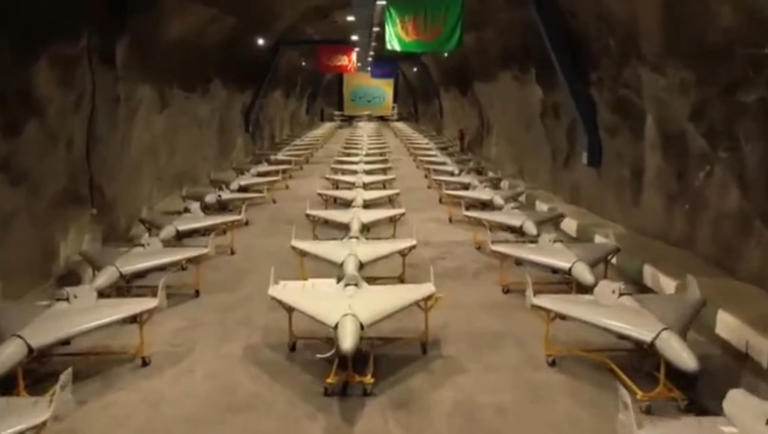
Iranian naval suicide drones hidden underground.
Since Iran can continue to hold the Strait of Hormuz hostage by lobbing the occasional missile or drone at an oil tanker, the question becomes, how long can the US maintain its presence outside the Strait of Hormuz.
Every day the Strait remains closed is another day that global oil inventories are depleted, fuel prices go up, there are fuel shortages, and the petrodollar continues to die. How long can the US last outside the Strait? Not to mention there is public opinion and a midterm election coming.
Assuming the US reduces its presence, the invasion stage of the Second Signpost would begin in earnest, as well as the attack on the oil infrastructure.
Just remember, if the Signposts are true, the Persian Ram will achieve its goals per Daniel 8:4.
Conclusion
At this point, it looks like the IRGC can outlast the US military. If this is truly the case, the Second Signpost is “baked in” and now it’s only a matter of time, becoming a “when” and not “if” for the Second Signpost.
All the Iran War has done in the end is –
(1) allow the IRGC to blockade and control the Strait of Hormuz,
(2) erase price caps on oil to allow it to increase greatly in price, and
(3) bake in the Third Signpost’s famine by preventing one-third of the world’s fertilizer from providing one-third of the world’s food to its 8 billion people.
We don’t have much time left to prepare. Don’t put things off.
Keep watch.
Categories: In The News, Signpost #2: Iran, USA in the End Times, World in the End Times
 THE FOUR SIGNPOSTS
There is also:
(4) deplete US ammunition stores, and have some very expensive and rare radar planes and radar equipment destroyed, both making the US weaker in respect to China.
And about (3):
Roughly half of all the world’s food comes from industrially made fertilisers based on natural gas and oil. Of this half, one-third is no longer coming out of the Gulf, so we lose one sixth of the world’s food. Not one-third.
The world has roughly 8 billion (8*10^9) people. One-sixth of that is 1,3 billion people.
High prices will stimulate frugality, efficiency and less wasting of food.
Also human creativity and inventiveness will find some alternate ways to make some fertiliser, growing crops that need less fertiliser, reapplying it away from flowers towards edible plants, etc.
So my educated guess is that the lives of one billion people will be at stake next year.
All of this is not only about plant food: grains, vegetables, fruits, potatoes etc.
Many chickens, pigs and cows nowadays are fed soy based food.
Soy needs fertiliser, so the supply of soy-based food for animals will go down too.
Once that effect strikes, many animals will have to be butchered because there is not enough food for them any more; roughly one-eighth of all the world’s farm animals, per the reasoning above.
Some of all this surplus meat can be stored in freeze-warehouses, or put in tin cans, or dried.
But I expect that this can only be a small part.
The rest will flood the market with a short-lived surplus of cheap meat, temporarily compensating for the plant food shortage.
After that, the world will have to do with one-eighth less of meat, dairy and eggs.
Of course all these shortages will be unevenly distributed across the world. Some regions will lose (much) more than one-eighth, other regions less.,
Perhaps someone with more knowledge of the world’s agriculture can improve my reasoning.
Adamant,
You are likely right about the one-sixth of the crops cut off and not one-third. However, that is still 1.33 billion people. Flowing down to the animals, perhaps you mean 1/6 of all the animals, not 1/8. Although globally it might be only 1/8 of the animals or less, since many poorer places in the world don’t have a lot of meat in their diets.
Regarding fertilizer, I know that out here in Colorado in the rural areas there are mounds of horse and cow manure not being used, it seems. It might still be put to good use.
@Mark, I meant 1/8 of the people and 1/8 of the animals will be in the danger zone, because part of the shortages can be mitigated by creativity and frugality. So less than 1/6, and 1/8 is my rough guess. But it could be 1/7 or 1/9.
And yes, using surplus manure is the first mitigation to think of. In the Netherlands too we have quite a lot of that. But there is a problem:
Most of the top soil in the world that is used by modern industrial agriculture is not only depleted of nutrients, requiring lots of fertiliser to grow anything at all.
It is also depleted of natural life: natural bacteria, fungi and other micro organisms. Whatever life remains in modern top soil is completely adjusted to fertiliser.
If you put natural dung on it, you will get a harvest better than nothing, but way less than with the fertiliser. It can take several years before the soil life is back to natural, and you get the maximum output possible with natural dung.
(Maybe this can be sped up by initially mixing remaining fertiliser with dung. But I do not know enough about agriculture and microbiology to say.)
And because of the decrease of the number of animals I wrote about, the amount of available natural dung will decrease too.
Adamant,
Thanks for the clarification. It makes sense.
@Adamant, it makes me wonder if adding a layer of organic soil helps to process the manure faster. There may be something similar regarding regenerative farming.